Stop Buying Cheap Western Gear: Why Quality Outerwear Is the Smartest Investment You'll Make
Let's have an honest conversation about western wear and money.
Every few months, a new wave of cheap western-inspired jackets floods the market — usually timed to a Yellowstone season premiere or a country music moment — and a lot of people buy them. The price is right, the look is close enough, and the photos on the website are convincing. Then six months later, the lining is peeling, the snaps won't stay closed, and the whole thing has that sad, washed-out look that no amount of care can reverse.
Then they buy another one. And the cycle continues.
Here's the thing: a genuinely well-made western jacket — canvas, leather, or shearling — doesn't work that way. It gets better with time. The canvas softens and molds to your body. The leather develops a patina that can't be faked or manufactured. The hardware stays solid because it was made to be solid. You wear it for a decade and it looks more interesting than it did on day one.
That's not marketing language. That's just how quality materials and honest construction behave over time. And when you do the math, it's not even close.
The Real Cost of Cheap Western Wear
Consider this scenario: you buy a $60 western-style jacket at a fast-fashion retailer. It looks decent for a season, starts to fall apart in year two, and is unwearable by year three. You replace it. Over ten years, you've spent $200 and owned three jackets that never looked quite right.
Now consider a $300 canvas rancher jacket from a reputable western outerwear maker. It's a bigger upfront number, no question. But with basic care — occasional waxing if it's waxed cotton, proper storage, prompt repair of any minor damage — that jacket lasts fifteen to twenty years without blinking. The cost per year drops to somewhere around $15 to $20. And it looks dramatically better at year ten than the fast-fashion version did at year one.
This isn't a new concept. It's what our grandparents called "buying once and buying right." Western wear, specifically, has always operated on this philosophy because it was originally made for people who couldn't afford to replace their gear every season. The durability wasn't a selling point — it was a survival requirement.
What Separates Real Western Outerwear from the Imitations
Once you know what to look for, the difference between authentic western outerwear and a fast-fashion copy becomes pretty obvious. Here's where to focus your attention:
Materials First, Always
The fabric tells you almost everything. Genuine western outerwear is built from materials with a track record: heavyweight cotton canvas (typically 10 to 14 oz), waxed cotton, full-grain or top-grain leather, boiled wool, or genuine shearling. These materials have been used in workwear and outerwear for well over a century because they perform.
Fast-fashion western jackets typically use polyester blends, bonded leather (which is essentially leather dust pressed onto a fabric backing), or lightweight cotton that looks like canvas but doesn't behave like it. Bonded leather, in particular, is worth calling out specifically — it peels, cracks, and separates from the backing within a year or two of regular wear. Real leather doesn't do that. Real leather just gets better.
When you're evaluating a jacket, ask about the fabric weight and composition. A canvas jacket should feel substantial in your hands. If it feels light and papery, it's not going to hold up.
Construction Details That Matter
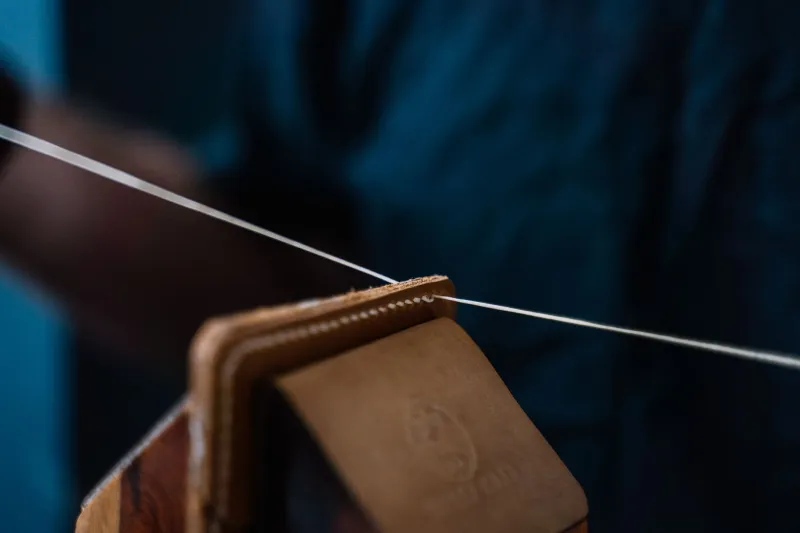
Flip the jacket inside out and look at the seams. Quality western outerwear uses reinforced stitching at stress points — armholes, pocket openings, collar attachments — because those are the places that fail first on a poorly made garment. Double or triple stitching at these points is a good sign. Overlocked seams that are finished cleanly suggest a manufacturer who cares about what you can't see as much as what you can.
Check the hardware. Snaps, buttons, and zippers on quality western wear are typically solid brass, nickel, or heavy-duty coated metal. They should feel weighty and click with authority. Plastic hardware or lightweight metal that flexes when you press it is a red flag — it'll fail under regular use.
Look at the lining. A properly lined jacket should have a lining that's attached at the edges but has some give in the body — this prevents the lining from pulling and tearing when you move. Linings that are fully fused to the shell or that feel tight and restrictive are typically a cost-cutting measure that shortens the garment's useful life.
Brand Heritage and Transparency
This one requires a bit of research, but it's worth doing. Brands with genuine western heritage — the ones that have been making outerwear for ranchers, rodeo workers, and outdoor laborers for decades — typically talk openly about where and how their products are made. They name their materials. They describe their construction methods. They stand behind their work with meaningful warranties.
Brands that are cashing in on a trend tend to be vague. "Premium materials" without specifying what those materials are. "Durable construction" without explaining what that means. If a brand can't or won't tell you what their jacket is made of and where it was made, that's information in itself.
This doesn't mean every American-made jacket is great and every imported jacket is bad — that's an oversimplification. But domestic production and transparent supply chains are often indicators of a brand that's serious about quality control.
The Pieces Worth Spending On
Not every item in your wardrobe needs to be a heritage investment. But certain western pieces are worth prioritizing for quality because they're the ones you'll wear constantly and that form the visual foundation of the look:
The canvas or waxed cotton rancher jacket. This is your workhorse outer layer. Buy the best one you can afford. It'll be with you for years.
A leather or shearling vest. A quality vest transitions across seasons and adds warmth without bulk. Full-grain leather or genuine shearling only — the alternatives don't age the same way.
A heavyweight flannel shirt jacket. Look for 100% cotton flannel with a weight above 5 oz per square yard. This is a piece you'll reach for constantly from September through April.
Leather boots. Not outerwear, strictly speaking, but boots are where a lot of people make the cheap-vs-quality mistake. Goodyear-welted boots with a full leather insole can be resoled multiple times. Cemented soles cannot. The construction method matters as much as the leather quality.
The Bottom Line
Western wear at its best is a long-term relationship, not a transaction. The jacket that costs three times as much as the fast-fashion version will likely outlast it by a factor of five or ten — and it'll look better the whole time.
The Yellowstone aesthetic that's captured so much attention isn't just about the look. It's about the idea behind the look: things built to last, gear that earns its character, clothes that mean something. You can't get that from a $60 polyester blend. But you absolutely can get it from a jacket that was made the right way, from the right materials, by people who know what western outerwear is actually supposed to do.
Buy it once. Buy it right. Wear it for the next twenty years. That's the western way — and it's better advice now than it's ever been.